











Welcome to the fourth issue of Asian Glass for 2026.
Precision has always mattered in glassmaking, but these days it stretches well beyond the production line. Manufacturers want tighter control over quality, energy use, raw materials and supply chains – all while responding to shifts in technology, costs and demand.
Our cover story picks up that thread. Yogender Singh Malik reports on how artificial intelligence (AI), automation and advanced vision systems are reshaping glass inspection across Asia. With production speeds rising and products getting lighter and more technically demanding, inspection is no longer just a final check for defects – it is becoming part of the manufacturing process itself, helping producers improve quality, consistency and efficiency.
Solar glass has strong long-term prospects as solar power keeps expanding worldwide. Rohan Gunasekera looks at a sector caught between that promise and a harder present: rapid capacity growth has left it oversupplied and under price pressure. Trade measures, and unease over reliance on Chinese supply, are pushing more countries to develop their own solar manufacturing capabilities.
Further upstream, Jahir Ahmed covers Asia’s soda ash market, where expanding Chinese capacity and softer downstream demand have opened up a sizeable surplus. Glassmaking remains the biggest source of demand for it, even as solar glass and other industrial uses reshape production and trade flows.
A similar tension runs through ASEAN’s glass tableware industry. Yogender writes about how Southeast Asia has established itself as an important production and sourcing hub, helped by strong domestic consumption and buyers diversifying their supply chains. Rising costs and stiffer competition mean capacity alone will not be enough – quality, design and reliability will increasingly determine future growth.
Reliability does not stop at the factory gate. Glass is heavy and fragile in equal measure, and moving it takes specialist handling every step of the way. Jahir looks at how shifting trade flows, rising costs, digital tracking and regional distribution are reshaping glass logistics across Asia. Our freight forwarding and logistics supplement takes this further, mapping the ports, carriers, warehouses and forwarders that get Asian glass to market.
Rohan’s Nation in Focus turns to the US. Government support, trade policy and a push to strengthen domestic supply chains are driving investment and modernisation there, although the picture varies considerably from one glass sector to the next.
We also take a look at vacuum insulated glass – thermal performance and acoustic insulation combined in a relatively slim unit. It is a combination drawing more attention as cities grow, noise persists and building-energy requirements tighten.
And looking further ahead, the international glass industry heads to Düsseldorf in October for glasstec, where automation, digitalisation, energy efficiency and advanced processing will again dominate the conversation. It is a good chance to see the latest technology in person and hear directly from manufacturers and suppliers about how they are tackling the issues facing the industry.
It is shaping up to be a busy few months for glass, and we will keep tracking these stories across Asia and the wider international market.
As ever, we hope this issue of Asian Glass gives you a useful read on the markets, technologies and trends shaping the industry.
Enjoy the issue.




Inside the current issue
News, views, raw materials, comment and much, much more!
See us at:
Check out a sample issue
Follow the link to download a whole sample issue for yourself and see what AG has to offer Read it now
Subscribe
Stay up to date with the latest news and features!

Advertise
Intuitive, bespoke, highly effective marketing campaigns.

Editorial
Download our editorial features schedule today.
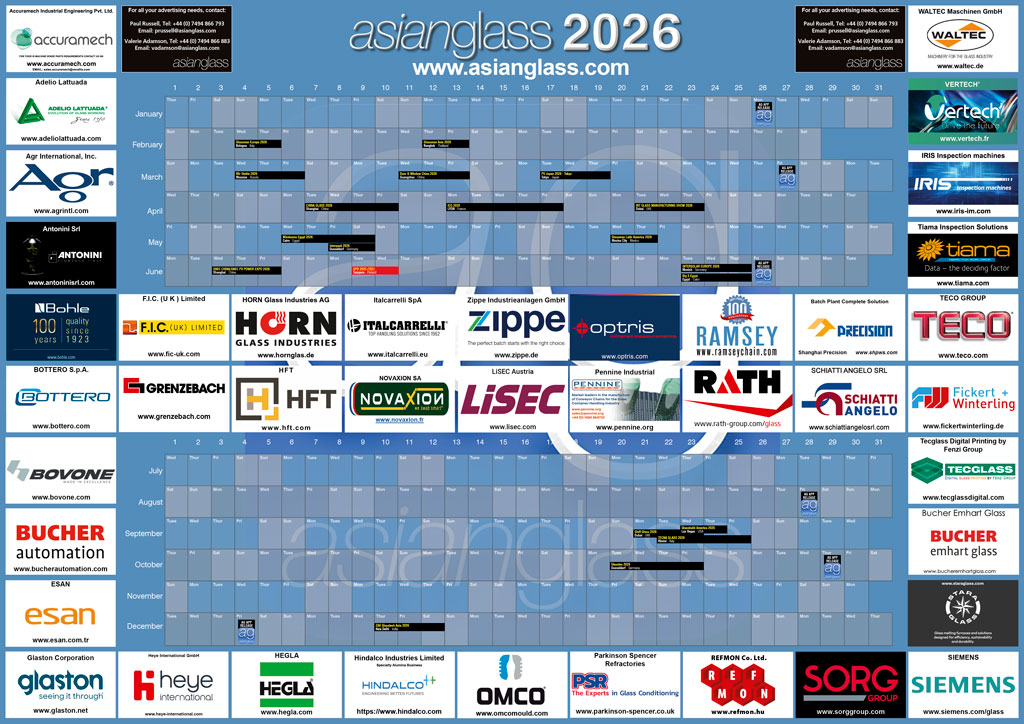
Year Planner
Map out your business year with our free to download calendar.